
The Sin Cycle
Everything God touches, turns to good. Yes! Even our sins!
In fact, every mistake is a learning opportunity and the bigger the mistake, the bigger the lesson. Does this mean we should encourage sin? Of course not, but our experiences (even the bad ones) shape us. Like most things in life, there is a rhythm. There is even a rhythm for our redemption. I call it the sin circle.
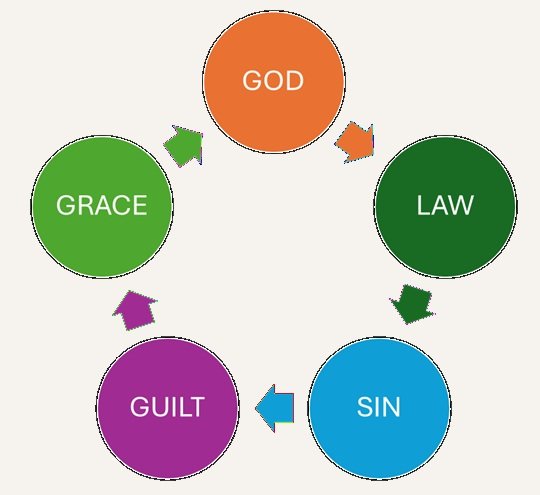
At the top of the circle we have God (where else?) who gave us the law. It is the law that keeps us on track and lets us know whether we are on the road or in the ditch. When we do get off track, this is called sin. To get back on track, we need an incentive to do so and this incentive is called guilt. But we can’t just stay mired in our guilt because if we did we would never find God. So God sends His grace in the form of confession and redemption so that we can close the circle and come back to Him. Remember that God desperately wants to be with us and He is constantly seeking us out and waiting for us to come home to Him.
Let’s take a look now at the individual parts of this circle.
God
Did you notice that nothing on this circle is tangible (in the sense that it is a physical thing)? Yet few would be so narrow minded as to believe that God, sin, guilt, law and grace do not exist. Don’t get me wrong; by saying it is not tangible I mean it only in a physical sense. It is metaphysical,[1] but not physical. In no way am I denying its importance or its existence. In fact, we are inundated every single day with intangible things like this that critically impact and affect our lives (things like emotions, ideas, dreams etc.). In fact, most of our life is little more than a stream of consciousness that is in itself, intangible. There truly is a battle each and every day that goes on within the confines of our skulls that guide, shape and mold us – and yet none of it is tangible! It’s amazing to think that untold thousands of decisions are made every day in the confines of our head and not one of them can be quantified in a physical sense.
So does it surprise you to realize that so much of your life is spent battling an invisible foe like sin? It shouldn’t. St. Paul warned us about this very thing.
For our struggle is not against flesh and blood, but against the principalities, against the powers, against the world forces of this darkness, against the spiritual forces of wickedness in the heavenly places.[2]
So our battle then is not with each other; it’s with Satan and his minions and because we are created in the image of God we are God’s foot soldiers. This is why we are also the enemy of Satan. It’s simple logic:
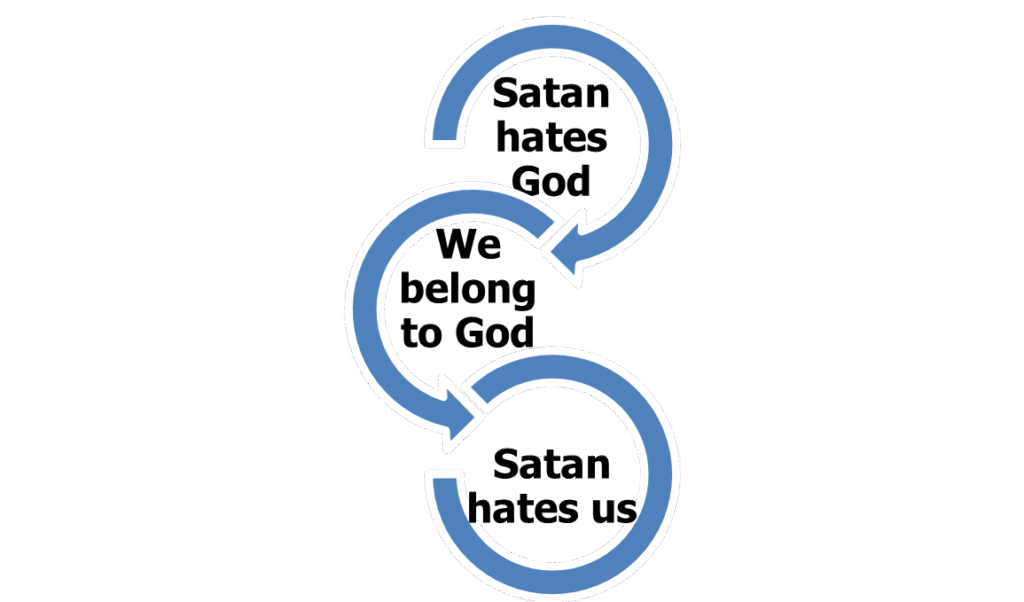
Consequently, we are caught in the middle of a great battle – like it or not.
The Law
God did not cast our fore-parents out of Eden and then turn His back on them – no way! He gave them (through Jesus) a path back to Him. Neither did He leave us orphans, abandoned to fend for ourselves. He left His law and the Holy Spirit with us. Let’s look in depth at Romans 7:7-8 to see what the law is all about:
What shall we say then? Is the Law sin? God forbid! On the contrary, I would not have come to know sin except through the Law; for I would not have known about coveting if the Law had not said, “you shall not covet.” But sin, taking opportunity through the commandment, produced in me coveting of every kind; for apart from the Law sin is dead
Clearly then, it is the law that reveals our sin. For without the law, we would not even know that we were sinning. Did you catch that last part – “for apart from the Law sin is dead”? In other words:
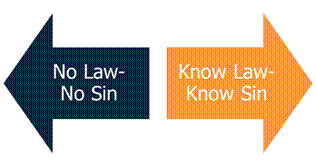
The law is therefore like an x-ray that shows a cancer in the body. The x-ray itself doesn’t cure the cancer and it doesn’t encourage or discourage the disease. It only shows it. Whether you do something about the cancer is up to you. Or, if you prefer; sin is like hunger. If you didn’t have it you wouldn’t know when to eat. But hunger itself doesn’t make you fat or thin. It’s what you do with the hunger that affects you positively or negatively. Likewise, when you are aware of your sin and you have a healthy amount of guilt, your sin should propel you to hunger for God’s forgiveness. Sin is therefore unavoidable but rather than “sinning boldly”[3] with reckless abandon, sin must be managed.
Remember that Christ came “not to abolish the law, but to fulfill it”.[4] This means that the original, Old Testament law, given by God the Father was perfect; it only needed to be clarified and refocused by Jesus. Jesus did not change the law (“not one tittle” according to the Bible[5]) but He did greatly simplify it when He said:
“And a lawyer stood up and put him to the test, saying, “Teacher, what shall I do to inherit eternal life?” And he said to him, “what is written in the law? How does it read to you?” And he answered, “You shall love the lord your god with all your heart, and with all your soul, and with all your strength, and with all your mind; and your neighbor as yourself.” And he said to him, “you have answered correctly; do this and you will live.” [6]
So why did Jesus need to refocus us? Because we had gotten off track. God gave Moses Ten Commandments but somehow later in the Pentateuch[7] we ended up with Six Hundred Three additional ones. [8] But these additional laws were something that the people added so rather than clarifying the law it only added more complexity. Additionally, at least one of these laws was opposed to God’s law, and Jesus confirmed this overstep in the Book of Matthew:
“They said to him, “why then did Moses command to give her a certificate of divorce and send her away?” He said to them, “because of your hardness of heart Moses permitted you to divorce your wives; but from the beginning it has not been this way.” [9]
In other words, the law, while useful, can be stretched, misused and abused. It therefore seems that simpler is better concerning the laws of God. Because the written law can be abused, God elevated mankind to a position above the law when He wrote His laws on mankind’s heart.[10] This is why Jesus distilled all Six Hundred Thirteen Old Testament laws into two; Love God and love your neighbor. In fact, all of morality can be defined by these two elegantly simple rules.
These two laws then are like two guardrails for us on the highway to heaven. But did you ever notice that when you drive, you tend to focus not on the guardrail, but on the road ahead? In fact, the guardrail usually disappears in your peripheral vision when you drive. Ideally, sin should be like this. We don’t constantly need to stare at it, we just need to know obliquely that it is there. We definitely want to avoid rubbing up against it as we are driving, but we do need to monitor it so that we know where our limits are. For example, we do not need to be reminded that killing is sinful, in fact most of us (at least I hope most of us) will go through today without having to remind ourselves that murder is wrong.
The goal therefore is to constantly focus on the goal ahead. Like a football player who is “in the zone” it is the goalposts that are his focus and little else. He avoids his tacklers of course, but he keeps moving forward and is only obliquely aware of them until they get in his way and he has to deal with them directly. When this happens, he deals with the problem head on and continues to drive forward across the field. Likewise, we should not ignore the law completely, rather we should keep our eyes focused on the end goal – heaven.
Sin
This is how sin always starts – slowly and incrementally. No one wakes up and says, “I’m going to become a serial killer today”. Such big sins always start small. Perhaps by stealing a pencil from school or cheating on a test. Then it’s on to shoplifting and stealing larger things. Then over the years we graduate to grand theft, breaking and entering, assault and battery and then…that first murder. Once there, “why stop?” the devil says. Nope. No one becomes a major sinner overnight. It takes a lot of practice and dedicated hard work to become a top-notch sinner!
Ok… all sin is bad, but is all sin the same?
Actually, there are many different types of sin. Mortal sin, venial sin, intentional sin, unintentional sin, sins of commission, sins of omission and so on. Sin is diverse and it is ubiquitous. I’m not saying this to depress you; I’m saying this to remind you that sin is unavoidable. We sinned yesterday, we will sin today and we will sin tomorrow. Period. Got it? Good. Now move past it!
There are a lot of ways to describe individual sins but not a lot of ways to describe what sin actually is. It’s like a headache; we know how to describe what it feels like but we stumble to describe precisely what it is.
Guilt
Let’s examine guilt now. If we sinned and didn’t have guilt we wouldn’t care if we’d sinned or not. But we do care because we have a conscience and it is our conscience that convicts us. Remember; we are at war and it is our mind that is the battlefield. So how is it that the billions of people living in the world today all have the same basic conscience? Because God put it there! We all know right from wrong and we sometimes go to great pains to convince ourselves that a wrong action or bad behavior is not really wrong or bad (in other words, we try to justify our wrongs). But isn’t it interesting that we never have to convince ourselves about what is right in the first place? Remember that Jeremiah 31:33 (go back two pages) told us that God’s law is written into our very DNA!
Guilt is a very powerful tool and like everything else, it is open for misuse by Satan. As we saw previously in figure 3-1 (The sin process) guilt follows sin and precedes grace. Therefore, guilt is the linchpin in the process and as such, it is where Satan attacks us most often.
This is no surprise since he always attacks us at our weakest point. With Satan now in the mix, we break the law, we sin, we feel guilty and then…Satan throws the law back in our face and the cycle continues.
It looks something like this:
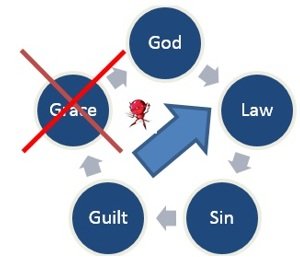
As you can see, the process is now short-circuited. Satan “reminds us” that we broke the law. He accuses us (“the accuser” by the way one of his titles), we regret our sin and we are thus inundated by guilt. This cycle goes around and around to the point that we become so paralyzed with guilt that we never seek God’s grace and forgiveness. This is a very effective attack! In fact, Satan’s biggest victory employed this very strategy against Christ Himself. How you ask?
Did you ever notice the irony that the only disciple to defend Jesus before His accusers after He was condemned was Judas? Think about it. All of the others left Jesus but only Judas went back to try to save Christ:
“Then when Judas, who had betrayed Him, saw that He had been condemned, he felt remorse and returned the thirty pieces of silver to the chief priests and elders, saying, “I have sinned by betraying innocent blood.” But they said, “What is that to us? See to that yourself!” And he threw the pieces of silver into the temple sanctuary and departed; and he went away and hanged himself.” [1]
Judas knew full well that what he did was wrong and he fell into Satan’s trap of guilt. Had Judas sought out Jesus (i.e. sought out God’s grace) and asked for forgiveness, do you think Jesus would have given it? Of course he would have! And if he had, our view of Judas would be drastically different than it is today.
Do you see how powerful a tool guilt is? If used the way God intends, it will save a person by bringing him or her closer to God, but if misused it can destroy a person entirely.
Grace
So how do we break out of this death spiral? Grace! God gives us grace to overcome the guilt and to turn away from sin and turn back to Him. Do not mistakenly think that because grace is intangible that it is feeble! Grace is the most powerful weapon we can wield because it is God’s weapon. Old Testament, New Testament; it doesn’t matter. The Bible is full of instances where God sends His grace upon those who are afflicted to aid them. For example, grace was poured out upon Paul to aid him in his mission:
“Three times I pleaded with the Lord about this, that it should leave me. But he said to me, “My grace is sufficient for you, for my power is made perfect in weakness.” Therefore, I will boast all the more gladly of my weaknesses, so that the power of Christ may rest upon me.” [1]
And grace was given to us as well, to build up our faith:
“But God, being rich in mercy, because of the great love with which he loved us, even when we were dead in our trespasses, made us alive together with Christ—by grace you have been saved—and raised us up with him and seated us with him in the heavenly places in Christ Jesus, so that in the coming ages he might show the immeasurable riches of his grace in kindness toward us in Christ Jesus. For by grace you have been saved through faith. And this is not your own doing; it is the gift of God, not a result of works, so that no one may boast.” [2]
In fact, grace and faith go hand-in-hand:
“Therefore, since we have been justified by faith, we have peace with God through our Lord Jesus Christ. Through him we have also obtained access by faith into this grace in which we stand, and we rejoice in hope of the glory of God.” [3]
So it is not by grace alone, nor by faith alone that we are saved. Nor is salvation or grace attainable by our works. It is by our faith in God that He gives us grace so that we can accomplish His works here on earth.
We must have faith to receive grace and we must have grace to win the battle and when faith and grace meet within us; who can stand against us?

[1] 2 Corinthians 12:8-9
[2] Ephesians 2:4-9
[3] Romans 5:1-2
[1] Mathew 27:3-4
[1] Metaphysics is a branch of philosophy that deals with the nature of things
[2] Ephesians 6:12
[3] Martin Luther once wrote “God does not save those who are only imaginary sinners. Be a sinner, and let your sins be strong – sin boldly!” https://www.iclnet.org/pub/resources/text/wittenberg/luther/letsinsbe.txt
[4] Mathew 5:17
[5] Matthew 5:18
[6] Luke 10:25-28
[7] The Pentateuch consists of the first five books of the Bible
[8] Pious Jews devoutly observe all of these laws to this day
[9] Matthew 19:7-8
[10] Jeremiah 31:33
[11] 1 John 5:16-17
[12] See Appendix C – Act of Contrition